Often you hear about a player before you see them.
Anyone who follows sport can relate to that feeling, whether you’re a kid playing for your local team or a fan hearing about your side’s latest signing.
When I was still playing, my team – declining and distracted by other interests – somehow got drawn against League of Ireland club St. Patrick’s Athletic in the first round of an under-18 national cup competition.
The match was played on October 21st, 2001. I know this because I used to keep notes of the games I played in – is it any wonder I became a sports journalist and commentator?
The rumour was that Pat’s had just recruited an out-of-this-world midfielder who’d been on the books of both Arsenal and Aston Villa. His name was Keith Fahey.
From memory we had about 13 players available, while Fahey ran the show in central midfield, scored a few goals, and generally looked a class apart.
Or did he? Most references online now suggest that the future Republic of Ireland international didn’t return home until a little later.
What my notes do confirm is that I was unhappy about being shifted out to the left wing – and for being taken off at half-time.
“As for the game,” I wrote. “5-0 at half-time and 9-0 at the finish tells its own story. They were a quality outfit.”
Funny, I’d always thought we had only lost 8-0.
What is certain is that Fahey went on to get a vital winner in Armenia that helped Ireland qualify for Euro 2012, as well as to lift the League Cup with Birmingham City during his second stint in England. And, of course, that he was a bloody good player.
Thoughts of that Pat’s game came to mind when a big transfer triggered another memory. Like Fahey, Liverpool midfielder Thiago Alcantara is a gifted playmaker. And he was another player that I had heard about before I saw him in the flesh.
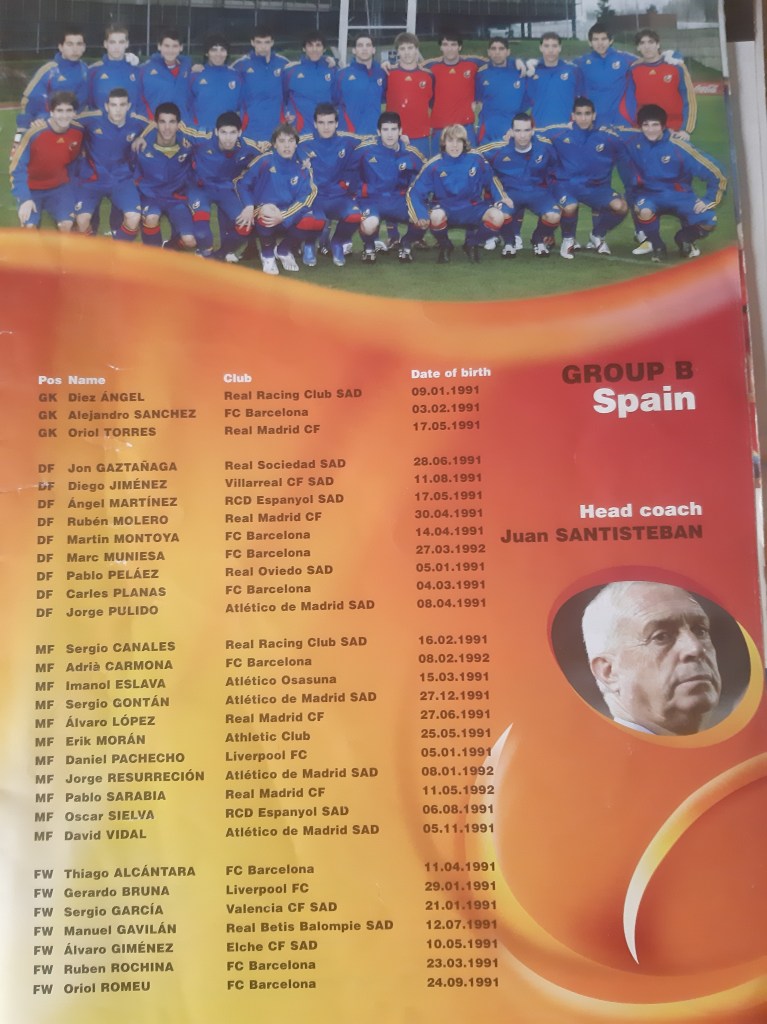
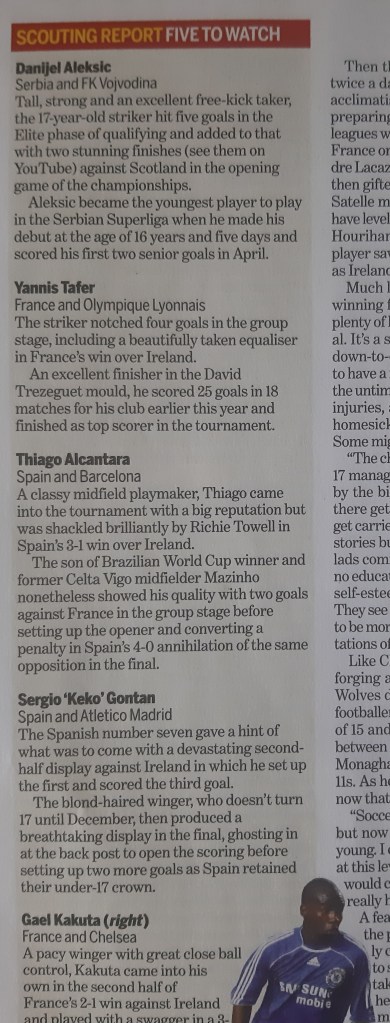
In May 2008, I was sent by the Sunday Tribune to cover the European under-17 championship in Turkey. Antalya on the Mediterranean Coast was hosting the tournament, and Ireland were in a group with Spain, France, and Switzerland.
With Robbie Brady on the wing, Sean McCaffrey’s side performed well in 35 degree heat in their opening game. A certain Alexandre Lacazette came off the bench, however, and in injury-time he thumped home a wonder goal to snatch a 2-1 win.
Switzerland – who only introduced Xherdan Shaqiri in the final minute – then ended Ireland’s chances of qualifying with a 1-0 victory.
By that stage, everyone there knew about Thiago. The son of 1994 World Cup winner Mazinho had scored twice in Spain’s 3-3 draw with France, and he was the player to watch in Ireland’s final group game.
It was Conor Hourihane who stood out initially though – he put Ireland in front in the 3-1 defeat – while Richie Towell did a good job of limiting Thiago’s influence.
The future Champions League winner was as classy, composed and graceful as ever on the ball – and probably saving himself for a bigger stage. Having just turned 17 before the tournament, the Barcelona youngster made the first and scored the second in a 4-0 rout of France in the final.
Kylian Mbappé, meanwhile, was well established by the time I got to see him live. I remember voicing a Monaco friendly one year and being glued to the screen during half-time. The highlights were being played on a loop and from every angle, and one of them centred on a bit of skill the teenager had produced to glide by an opponent. It had to be viewed several times to work out exactly what Mbappé had done, and even in slow motion it looked fast.
In May 2018 I got to see Mbappé in person for the first time. He wasn’t at full pelt, because France were preparing for the World Cup and coasting to a 2-0 win over a weakened Irish side in Paris.
But as well as for the camaraderie, drama, loyalty, and passion – on the pitch and in the stands – the individual brilliance of people like Mbappé is one of the reasons we all pay in to watch live sport.
The speed with which the Paris Saint-Germain attacker moved in tight spaces that night was a sight to behold. Those magic moments, which leave the whole crowd almost unknowingly gasping for air, are part of what makes sport special.
The player is unaware, of course, but it feels like you’ve had a shared experience. And seeing that kind of talent stirs up the same emotions you have when you see a particularly memorable gig or show. Your eyes widen and your smile broadens as you recount the experience by saying “I was there.”
The next time Mbappé sprinkled some stardust my way was in September the same year. Germany drew 0-0 with France in a largely forgettable Nations League tie in Munich, but the 19-year-old stood out a mile.
We got talking to Chelsea defender Antonio Rüdiger afterwards, and I asked what makes the French star so special.
“Do you watch football or not?” Rüdiger joked.
“The thing is he’s unbelievably fast… his agility… his movement is deadly.”
Mbappé had wowed the crowed that night with his pace and trickery, and Rüdiger had some advice for anyone looking to try and keep him in check.
“You can’t do it alone,” he said.
“As a team, you have to try to stop him. Because alone – good luck!”
That brings me to the other end of the spectrum. Sometimes there are players you’ve heard about for a long time and seen several times before. And yet you still get the same sensation when you watch them in person.
I first observed Zlatan Ibrahimovic from the stands in June 2013 in Vienna, when the giant Swede – I wrote at the time – “was causing havoc in the air and dictating attacks on the ground.” He was let down by defensive errors elsewhere that evening, and the next time I was close at hand – for PSG’s 1-1 draw at Monaco in February 2014 – he cut a frustrated figure again.
The 6’5″ man mountain, then 32 and on 31 goals in all competitions that season, proved a real handful once more. His speed of thought and movement was a problem for a talented Monaco side and his brilliant footwork resulted in Ricardo Carvalho and James Rodriguez picking up yellow cards within a minute of each other.
Ibrahimovic didn’t get on the scoresheet in front of 48,000 fans in Austria, though, or 18,500 in the principality. But I was one of over 42,000 people inside the Parc des Princes when he cleverly chested home and then delicately touched in with his left foot in a Coupe de France win against Lyon in February 2016. They were just two of 50 goals the striker registered in his final season in Paris.
Next time I saw Ibrahimovic there were no paying customers but – two weeks short of his 39th birthday and in the midst of a pandemic – he still looked razor sharp.
AC Milan visited Tallaght Stadium in September 2020 for a glamour tie that – with Zlatan in town – would normally be an instant sell-out or moved to a bigger venue.
But class players who still have hunger don’t need an audience or much motivation to perform. This was “only” a Europa League second qualifying round tie, but the legendary frontman is already in AC Milan’s Hall of Fame and wants to go out in style if 2020/21 is his last season.
Milan winger Samu Castillejo said before the match that the former Manchester United and LA Galaxy star drives his teammates on because he’s a champion that can’t wait to win – “even in training.”
In the first competitive fixture of the season for the Rossoneri, imperious Ibra did a bit of everything. He dropped deep, raced into the channel, held the ball up, played through balls, sent over crosses, bounced off defenders – and scored. In a flash, midway, through the first half, he put Milan 1-0 up by shifting his feet and hammering home.
“Even today he’s still devastating, strong, in great shape,” ex-Italy striker Christian Vieri said in an interview that appeared the day after that 2-0 success. “And he always scores.”
Ibrahimovic, Vieri felt, would play for as long as he thinks he can make a difference. And why wouldn’t he? The former Sweden skipper looked as talented as when I’d first seen him – and every bit as good as I’d heard he would be.

 alwaysbeclosing